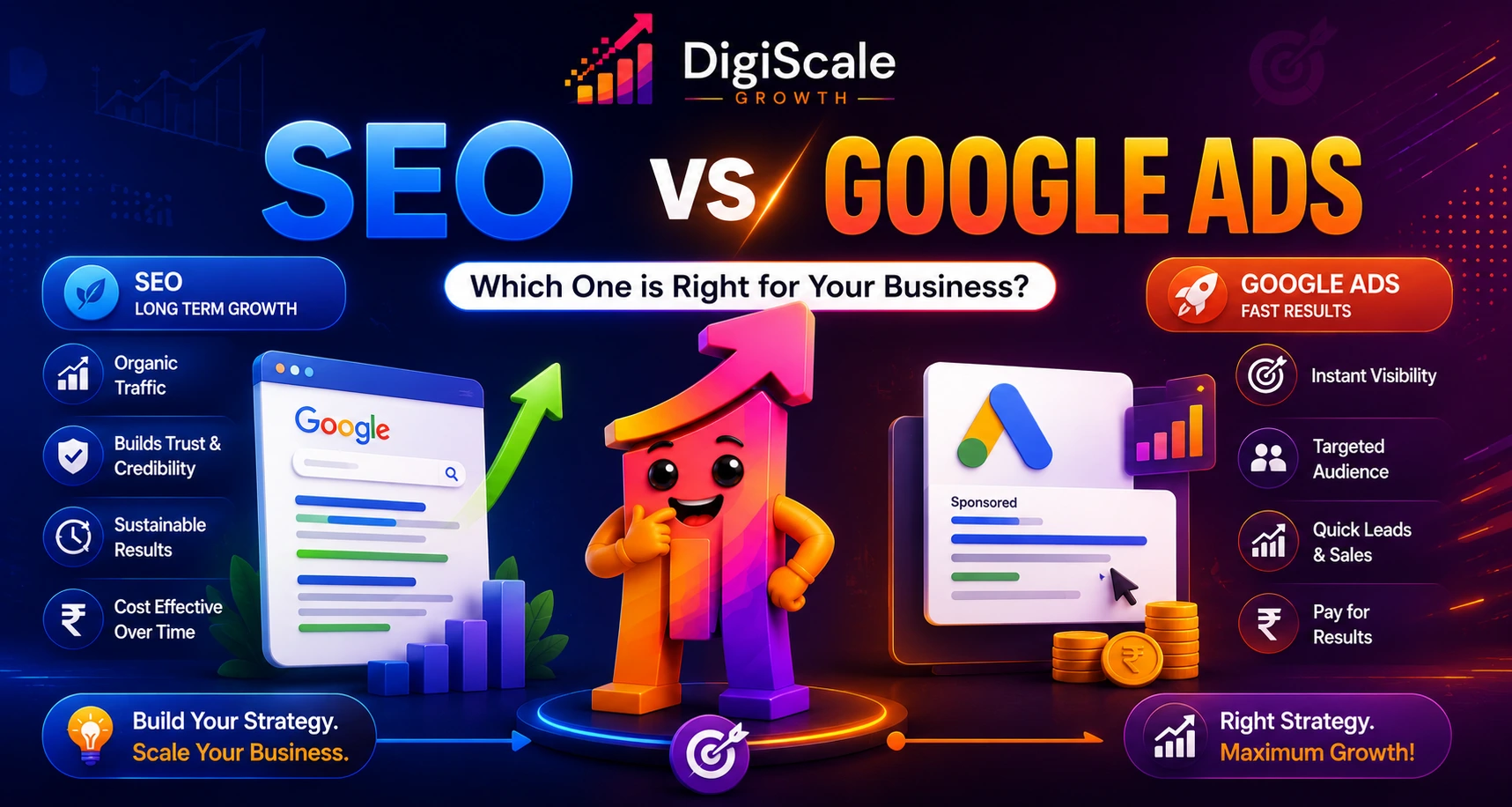
Yaar, be honest — how many times have you opened your laptop, Googled your own business, and watched your competitor sitting right there on top while your website is hiding somewhere on page 3? That feeling is frustrating. And the first instinct is usually: "Do I need to run ads? Or should I do SEO? Or both? But I don't have the budget for both..."
Sound familiar? You're not alone. This is genuinely one of the most asked questions from business owners across India — from small shops in Ahmedabad and Surat to service-based companies in Delhi and Bangalore.
And honestly? Most blogs on this topic give you the same boring, generic answer. They'll say "it depends" and then list a table comparing both without actually telling you what to do.
We're not going to do that.
In this blog, we're going to break it down the real way — with actual numbers relevant to the Indian market, real scenarios, and a clear recommendation based on where you are in your business journey. By the end of this, you'll know exactly which direction to take.
First Things First — What is SEO?
SEO stands for Search Engine Optimisation. In plain language, it means making your website show up on Google when people search for something related to your business — without paying Google for every click.
So if you run a graphic design agency in Ahmedabad and someone Googles "graphic design services Ahmedabad," SEO is what puts your website on page 1 of those results organically.
SEO vs Google Ads — The Honest Head-to-Head Comparison
Let's put these two side by side and look at what actually matters for a business owner in India.
How Does SEO Actually Work?
SEO works through three main pillars:
On-Page SEO — This is the work you do on your website itself. Writing content with the right keywords, optimising your headings, meta titles, page speed, and making sure your site is mobile-friendly.
Off-Page SEO — This is about building your website's authority. Getting other trusted websites to link back to yours (called backlinks), getting your business mentioned across the web, and building a genuine online reputation.
Technical SEO — This is the behind-the-scenes stuff. Making sure your website loads fast, has a clean structure, is crawlable by Google, and is set up correctly with schema markup so search engines can understand what your content is about.
When you do all three consistently, Google starts trusting your website and pushes it up in rankings. And once you're on page 1? Every click is free.
What Kind of Results Can You Expect from SEO?
Here's the real talk: SEO is not a shortcut. Results typically take 3 to 6 months to become meaningful, and in competitive industries, it can take up to 9 months.
But here's the beautiful part — once it works, it keeps working. Your website keeps getting traffic even when you're asleep. Even when you're on a holiday. Even when you're not spending a single rupee on ads.
Think of SEO like planting a mango tree. You water it for months without seeing fruit. But once it grows, you get mangoes every season — for free, year after year.
And What Exactly is Google Ads?
Google Ads (previously called Google AdWords) is Google's paid advertising platform. You set up campaigns, bid on specific keywords, write your ad, and your business appears at the top of Google search results — marked with a small "Sponsored" tag.
You pay every time someone clicks your ad. That's why it's also called PPC — Pay Per Click.
How Does Google Ads Work?
When someone searches a keyword you've bid on, Google runs a quick real-time auction among all the advertisers competing for that keyword. The winner doesn't just go to the highest bidder — Google also considers the quality and relevance of your ad and landing page (this is called Quality Score).
So if your ad and website are highly relevant to what the person is searching, you can actually outrank bigger advertisers who are spending more money. That's one of the best parts of Google Ads done right.
What Kind of Results Can You Expect from Google Ads?
Results with Google Ads can literally start within hours. Set up the campaign today, and by tomorrow morning you can already have leads coming in.
This is why so many new businesses and product launches use Google Ads. You need customers now, not in 6 months. Google Ads delivers that speed.
But here's the catch: the moment you turn off your ads, the traffic stops. Immediately. There's no residual value. Every rupee you spend is buying traffic for that moment — not building anything for the future.
Think of Google Ads like renting a shop on a busy street. As long as you're paying rent, customers walk in. The moment you stop paying, the shop disappears.
Cost — Where Does Your Money Go?
SEO Cost in India (2026) : A decent SEO service from a reputable agency in India typically starts from ₹8,000 to ₹25,000 per month depending on your industry and competition level. This covers keyword research, content, on-page fixes, and link building. The upfront cost is real — but over time, the cost per lead keeps going down as organic traffic builds.
Google Ads Cost in India (2026) : The cost per click on Google Ads in India varies significantly by industry. For general service-based businesses, CPCs typically range from ₹5 to ₹50 per click. For more competitive industries like real estate, legal services, or healthcare, CPCs can go from ₹80 to ₹600+ per click. On top of the ad spend itself, you'll also need budget for agency management fees if you're hiring someone to run it for you, which usually starts from ₹5,000 to ₹15,000 per month.
The honest bottom line on cost : SEO looks more expensive in months 1 to 3 when results haven't kicked in yet. But by month 12, SEO is delivering far more value per rupee spent. Google Ads can become a money pit if not managed well — especially if your landing pages aren't converting.
Speed — How Fast Do Results Come?
This one's simple. Google Ads wins on speed — no contest. You can have leads coming in the same day you launch.
SEO takes time. Realistically, you'll start seeing movement in rankings around month 2 to 3, and meaningful traffic growth around month 4 to 6.
So if you're a brand new business that literally needs customers this month — Google Ads is your answer for right now.
Trust and Click-Through — What Do Users Actually Click?
Here's something that doesn't get talked about enough. Around 94% of Indian internet users click on organic search results, and only about 6% click on paid ads, according to 2025 data from the Indian PPC market.
Why? Because people have learned to recognise ads. That little "Sponsored" badge makes many users scroll right past. Organic results feel earned. They feel more trustworthy.
This doesn't mean ads don't convert — they absolutely do. But it does mean that SEO, when done well, tends to bring higher-trust traffic that converts into long-term customers rather than one-time buyers.
Control — Who's in Charge?
With Google Ads, you have almost complete control. You decide exactly which keywords to target, which cities to show up in, what times of day to run ads, how much to spend daily, and you can pause or change everything instantly.
With SEO, there's less direct control. You're following Google's rules and working within Google's algorithm. Rankings can shift when Google updates its algorithm. You can't force Google to rank you overnight.
However, SEO done right actually makes you more resilient. A well-built website with strong authority isn't easily knocked down by a competitor with a bigger ad budget.
Long-Term Value — What Happens After 12 Months?
This is where SEO absolutely wins.
After 12 months of consistent SEO work, your website has domain authority. You have multiple pages ranking for different keywords. Your cost per lead is steadily decreasing. Traffic keeps coming in every day without additional spend.
After 12 months of Google Ads without any SEO investment? You have good data on what keywords convert. But the moment you pause your ads, you're invisible again. You've built nothing on your own property.
A brand appearing in both paid and organic results for the same search query captures up to 25% more total clicks than brands appearing in only one position. That's a data point worth remembering — having both is genuinely more powerful than choosing just one.
When Should You Choose SEO?
SEO is the right primary focus when:
You're playing a long game. You're building a brand that will still be here in 5 years. You're not desperately chasing leads this week.
Your budget is limited. If you have ₹10,000 to ₹20,000 per month for digital marketing, put it into SEO. Google Ads on a tight budget in a competitive niche will drain fast without enough data to optimise.
You're in a content-driven industry. Coaches, consultants, service providers, local businesses, healthcare, education — these sectors benefit enormously from SEO because customers research heavily before buying.
You want to build an asset. SEO-built organic traffic is a business asset. It increases the value of your company. It compounds over time. It doesn't disappear when you stop writing cheques.
You're ranking in Tier-2 or local markets. SEO combined with Google Business Profile is an absolute goldmine for businesses in cities like Ahmedabad, Surat, Jaipur, Indore, Pune, and Nagpur. Local intent searches have lower competition and very high conversion rates.
When Should You Choose Google Ads?
Google Ads is the right primary focus when:
You need leads right now. New business launch, seasonal offer, product launch, event promotion — anything time-sensitive where you can't wait 6 months for organic traffic to build.
You want to test the market quickly. Not sure if people are searching for what you sell? Run a small Google Ads campaign for 2 to 4 weeks. You'll know within days which keywords are converting and which ones aren't. This data is gold for your future SEO strategy too.
Your competitors are dominating organic results. If page 1 of Google for your main keywords is packed with established, high-authority competitors, breaking through organically in the short term is genuinely hard. Google Ads lets you compete immediately regardless of your website's age or authority.
You have a high-margin product or service. If a single customer is worth ₹50,000 or more to your business, even a ₹500 to ₹1,000 cost per lead via ads is perfectly profitable. Real estate, interior design, legal services, B2B software — these are cases where Google Ads ROI makes strong sense.
You're running limited-time promotions. Diwali sale. Year-end offer. Limited slots for a workshop. Festival campaigns. These are classic Google Ads use cases — launch fast, convert quickly, pause when the promotion ends.
The Truth? Most Indian Businesses Need Both — But in the Right Order
Here's the thing nobody tells you clearly: SEO and Google Ads aren't competitors. They're teammates.
The best-performing businesses in India aren't choosing one over the other. They're using both intelligently — at different intensities depending on where they are in their growth journey.
And here's a real insight: your Google Ads data makes your SEO smarter. When you run paid ads, you find out which keywords actually convert for your business — not just which ones get traffic. That conversion data is priceless for building an SEO strategy that focuses on what actually brings customers, not just visitors.
Similarly, your SEO content improves your Google Ads Quality Score. A website with strong, relevant organic content tends to get better quality scores on its paid campaigns, which means you pay less per click for the same position.
The Smart Way to Use Both Together
Months 1 to 3: Start with Google Ads to generate immediate leads and cash flow. Use this period to gather data on which keywords convert. Simultaneously, begin the SEO groundwork — website optimisation, Google Business Profile, and initial content creation.
Months 4 to 9: Your SEO is starting to gain traction. Some pages are ranking on page 2 or climbing page 1. Keep Google Ads running but start shifting budget focus. Use ads primarily for your highest-converting, most competitive keywords.
Month 12 and Beyond: SEO is now delivering consistent organic leads. You can reduce paid spend on the keywords where you now rank organically, and redirect that budget towards new markets, new services, or seasonal campaigns.
This phased approach is what gives Indian businesses both immediate results and long-term, sustainable growth. It's not either-or. It's both — in the right sequence.
What About Your Budget? A Real Look at Indian Market Costs
Let's be direct with rupee numbers because most guides give you USD figures that make no sense for the Indian market.
Monthly SEO investment:
- Basic SEO (local/small business): ₹8,000 – ₹15,000/month
- Standard SEO (competitive niche): ₹15,000 – ₹35,000/month
- Aggressive SEO (high-competition industry): ₹35,000 – ₹1,20,000/month
Monthly Google Ads investment:
- Minimum practical budget for data collection: ₹5,000 – ₹8,000/month
- Realistic starting budget for consistent leads: ₹10,000 – ₹25,000/month
- Growth-stage budget: ₹30,000 – ₹1,00,000+/month
- Add agency management fees on top: ₹5,000 – ₹20,000/month depending on scale
Average CPCs by industry in India (2026 estimates):
- General services: ₹5 – ₹30 per click
- Education and coaching: ₹20 – ₹80 per click
- Real estate: ₹80 – ₹300 per click
- Legal and financial: ₹100 – ₹600 per click
Healthcare and clinics: ₹40 – ₹150 per click
One more thing worth noting — during Indian festivals like Diwali, Onam, and back-to-school season, CPCs can spike 40% to 80% due to increased advertiser competition. Budget planning around the Indian calendar makes a real difference to your Google Ads ROI.
Frequently Asked Questions
So, What's the Right Call for Your Business?
Here's the simplest way to think about it:
If you need leads this month — Google Ads. If you're building for the next 2 years — SEO. If you're serious about real, sustainable growth — both, done right.
The businesses that are winning online in India in 2026 aren't debating SEO vs Google Ads. They've moved past that debate. They're using both as complementary tools in a single, unified digital marketing strategy. Google Ads brings in the leads that fund the business today. SEO builds the organic presence that powers the business tomorrow.
The question isn't really "SEO or Google Ads." The question is: "What does my business need right now, and what am I building for the long term?"
Answer that honestly, and the right strategy becomes obvious.
At DigiScale Growth, we've helped businesses across India navigate exactly this decision — not with a one-size-fits-all answer, but with a strategy built around your specific goals, market, and budget.
With 5+ years of experience, a data-driven process, and a team that does deep research before recommending anything, we make sure every rupee you invest in digital marketing — whether in SEO, Google Ads, or both — is working as hard as it possibly can for your business.
And if something needs to be adjusted or revised along the way? No drama. No extra charges. We just fix it.
If you're ready to stop guessing and start growing, let's talk. Visit digiscalegrowth.com/contact-us/ and let's build a strategy that's actually right for your business.